



If your school has been designated ATSI for special education subgroup underperformance, you’re likely exhausted. You’ve tried intervention programs, invested in professional development, and analyzed data until your eyes crossed. And yet, the needle barely moves. So, why do ATSI schools stay ATSI?
Here’s what we’ve learned from working with districts across the Southeast: The problem isn’t your effort. Instead, it’s where you’re looking.
The Well-Intentioned Mistake
Most ATSI improvement plans start the same way. First, teams pull assessment data showing performance gaps—students reading two grades below level, struggling with grade-level math, scoring below proficient on state tests. Then, they purchase intervention programs designed to address what students can’t do.
On the surface, it makes perfect sense. For instance, students can’t decode? Buy a phonics program. Struggling with equations? Add more math drill and practice. Having trouble comprehending grade-level texts? Provide simplified reading materials.
However, here’s the thing: performance gaps aren’t the problem. They’re the symptom.
What Your Psych Evals Are Actually Telling You
One reason ATSI schools stay ATSI is misunderstanding the impacts of disabilities. Buried in every psychological evaluation is the answer to a more important question. Not “What can’t this student do?” but rather, “Why can’t they do it?”
Consider this example: Two students might both struggle with decoding. However, one has weak working memory—they can’t hold letter sounds in mind long enough to blend them. In contrast, the other has poor verbal comprehension—they can’t connect the sounds to meaningful words they already know. As a result, these students need completely different instructional approaches, even though their performance gap looks identical.
This is the difference between a performance gap and a cognitive impact.
Performance gaps tell you what students are missing. On the other hand, cognitive impacts tell you why they’re missing it. Furthermore, when you address the why, the what starts taking care of itself.
The Remediation Trap
Another reason ATSI schools stay ATSI is teaching below grade level, usually well below. Here’s the hard truth about most intervention programs: they’re designed to address performance gaps through remediation. Specifically, they take students back to below-grade-level content and rebuild from there.
Nevertheless, the research is clear on this approach. It doesn’t work. In fact, it often makes things worse. While students are catching up on third-grade content, their peers are mastering fifth-grade standards. Consequently, the gap widens.
Yet when you understand cognitive impacts, everything changes. For example, a student with weak working memory doesn’t need third-grade content. Rather, they need grade-level content delivered with multisensory instruction—Elkonin boxes, tracing, picture supports, sand trays. These are the same fifth-grade phonics patterns their peers are learning, just adapted for how their brain processes information.
That’s acceleration, not remediation. Moreover, acceleration is what exits ATSI status.
The Shift That Changes Everything
What if your next IEP team meeting started differently? Instead of opening with “This student is reading at a 2.5 grade level,” imagine you opened with “This student has working memory challenges that make it difficult to register and maintain information.”
Suddenly, the conversation shifts. Rather than asking “what program should we use,” teams begin asking “what instructional strategies does this student need to access grade-level content.”
That’s the shift from performance gaps to cognitive impacts. Furthermore, it’s the shift that makes ATSI exit possible.
What Happens Next: Exit ATSI
We know this works because we’ve seen it. Districts that make this shift see measurable improvement in 90 days—not 3-5 years. As a result, teachers gain confidence because they finally understand why their students struggle. Meanwhile, students make progress because instruction finally connects with how their brains actually work.
The good news? You don’t have to figure this out alone. The framework exists. Additionally, the research supports it. Most importantly, the strategies are proven.
You just need to know where to look. And it’s not in the performance gap data. Instead, it’s in understanding the cognitive impacts that created those gaps in the first place.
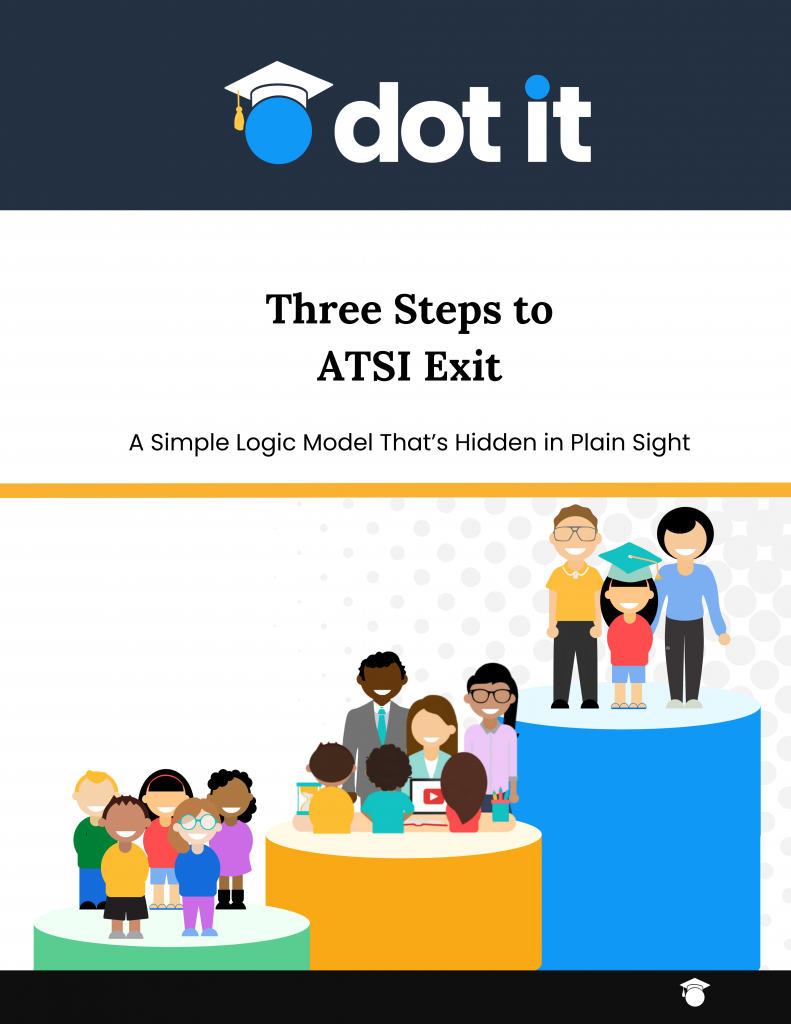
Ready to make the shift? Download our free guide: “The Three Steps to ATSI Exit” to see how impact-based planning creates measurable results.
Dot It helps districts exit ATSI status by shifting from performance gaps to cognitive impacts. Our platform makes it possible for teachers to plan, serve, and document instruction that addresses why students struggle—not just what they struggle with.